
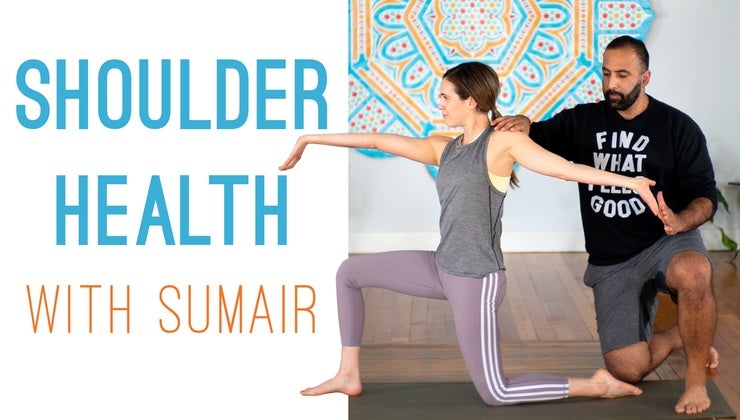
46:28
Shoulder Health with Sumair
video• 46:28• Premium
About this video
Type: video
Duration: 46:28
Access: Premium Content
Permalink: shoulder-health-with-sumair
Notes List

Karina2020-05-16 04:27:52 -0700
The video was very interesting and insightful I tried a practice doing the different breathing, I was super slow and lost engagement at some points, but already felt a difference in ease for some of the poses. Also the breathing helped focus my mind on ‘when does this not feel ok?’ I have some shoulder tension under the right shoulder blade and am trying to figure out how to best take care of it while keeping it strong. And the down-dogs, crows etc. make me nervous of damaging my shoulder.
I found paying attention to the content to understand and following along at home quite difficult. Would appreciate a more two-part video, with explanations first and then the exercises.
Anyhow - thanks ever so much for the video 😊

Ruth2020-05-18 12:44:31 -0700
Love these workshops. I seem to have a lot of trouble in the muscles along the inner border of both scapulae along with pain and cracking in my neck, chest and shoulders. I felt some relief after performing these movements. I would love some suggestions to improve strength and flexibility in my upper back! Thank you Sumair and Adriene :)

Carole2020-05-15 11:33:54 -0700
Hi Sumair, my right shoulder is rolled slightly forwards ( carrying handbags and children I think ), making anything in yoga to do with my right arm difficult- is there anything that can be done to correct the alignment please?
Thank you

Zethyn M2020-05-15 14:38:09 -0700
Thank you for the video, Sumair! I have a question about the exhalation. Initially you mentioned pulling up as you exhale and later you mention exhaling into the obliques. Are you meaning that as you exhale, pulling the navel up, you begin to activate the obliques? I could connect with the upward pull but didn't feel several of the connections you mentioned. I probably just need practice but knowing exactly what I should be doing as I exhale will help. Thanks!!

Tina2020-05-14 13:05:57 -0700
Hey - this might be a little too complicated of a situation but I have a question regarding applying this type of engagement in dolphin (without the step up because I mean I don't think it's physically possible to create enough space to do that in my body). I'm a yoga teacher and I had surgery on my right wrist in November. I am unable to perform ANY yoga pose involving body weight on the hands/wrists as of right now (not even tabletop). My orthopedist and my OT have given me permission to work on yoga poses involving forearms on the ground a few months ago (forearm plank, dolphin, etc). I was wondering if there is a DIFFERENT blueprint of muscular engagement/form for this family of movement? I'm having a really hard time finding resources for guidance...and my shoulder girdle just feels SOOOO bunched up. But either way, this video is great and I appreciate it, both as a teacher and student!

Chris2021-02-17 16:45:23 -0800
I'm using a cookie sheet under my towel for the second exercise because I have carpet. ;) I enjoyed seeing Adriene share that she is still learning, and seeing it here. This is an aspiring journey. ♥️

Kate Zuidijk2021-02-17 12:40:46 -0800
So I really really enjoyed this - it felt more like yoga theory rather than yoga practice, which I find so interesting. I do have one question; I have never been able to just sweep my foot through during the transition... I sort of have to move my hand out the way for it to come through. I noticed Adriene was doing it very slightly, but she just very gently takes her fingers to fingertips. So when she’s bringing her left foot through, she very slightly brings her left hand to fingertips, but I would have to move my left hand out of the way and put it back down again. Would that be more of a thing in my anatomy (I’m quite tall and have long legs), or is it a flexability thing? Loved this video though, really thoughtful and so much to think about!!!

Susan2020-05-18 08:26:14 -0700
This was amazing ! My shoulders and upper back felt so strong afterwards! My shoulders are 60 yrs old. My weakest points. So excited to return to this . Thank you so much! More please. ❤️ My husband will use this as well.

Lies Thys2020-05-15 10:28:23 -0700
This is SO good! I love it to be pointed to those 'details' that actually are essentials. Even when I only saw half of this video, I already felt that different nuance in my down dog to lunge during practice today.
Any chance there can be a made a short video with only the exercises as an addition to this video? So when you've watched it all, you can go practice with a good amount of repetitions and some visual cues without going through everything again?

Maria Marta Alfaro Chamberlain2020-05-14 09:11:55 -0700
Thank you for this new session. I just finished my calendar practice of the day and will come back to this one to study and implement. Namasté
Related Contents

Quick Stats
Content ID#439872
Category#
Typevideo