About this video
Type: video
Duration: 33:45
Access: Premium Content
Permalink: protecting-your-knees-in-lunge
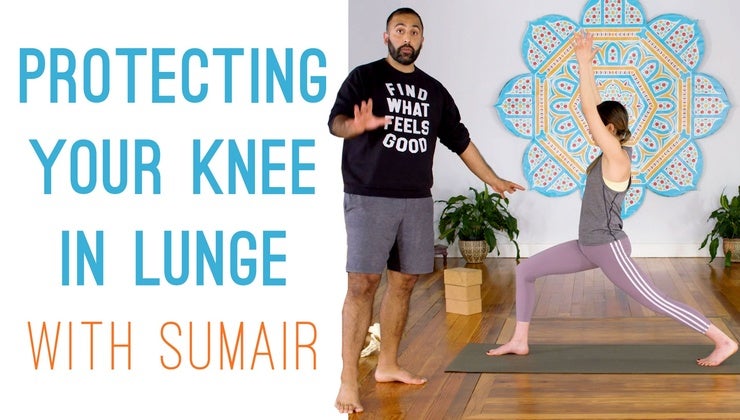
<p>When it comes to the knee joint or any joint for that matter, we have to look upstream and downstream from that joint to create stability and resilience there. As you can see from the anatomy model, the knee joint almost acts as the middle child between the hip and ankle. This means that if there isn’t the right balance of tension and slack between those joints, the knee can often begin to shear or have undue stress placed upon it. It gets more complicated than that and also becomes dependent on the lower back, upper spine, and even shoulders. However, for today's discussion we will simplify and talk about the three main joints that need stability in order to protect the knee joint. We will do this in the context of a downward dog to leg float to lunge transition. Now, if you haven’t already done the <a href="https://fwfg.com/programs/shoulder-health-with-sumair" target="_blank">shoulder health video</a>, first do that one in its entirety, and then come follow along with this one. It will set you up for success here. And even more so, I would check out the <a href="https://fwfg.com/programs/connection_vs_position_with_sumair_bhasin" target="_blank">"connection vs position"</a> video to understand transitions on your hands. </p><p><br></p><p>First movement we see is aimed at re-tensioning your hamstrings and lengthening your quads, hip flexors, psoas, and iliacus muscles. The hip learns how to tuck here as a result. </p><p><br></p><p>We start in a half kneeling shape. Make sure you get as much padding as you need for the knee. You want your kneeling foot to be up against your couch or even up against the wall for this pattern. Here is an idea of how you can navigate here: <a href="https://www.youtube.com/watch?v=zw3rUlovJgQ" target="_blank"><u>https://www.youtube.com/watch?v=zw3rUlovJgQ</u></a> </p><p><br></p><p>The closer your knee is to where your foot is resting, the more intense the movement. It is important not to force this pattern, but instead have your knee at a distance where you can create a hip tuck, lift that foot off, and not feel like you are about to rip your quads because you are tight. If you have blocks, the higher you stack the blocks the more intense it is, the lower you stack the blocks the easier. </p><p><br></p><p>I would start with the front knee down on the floor and forward to understand the pattern, and then slowly progress to that leg being up. The tuck is created using your brace. Draw your belly button or even rectum all the way up to your lateral ribs and up your middle back. If you feel like your pelvis wants to tuck, reinforce that tuck. You will feel a resultant pull in the front of your leg. Hold that for 1 minute first. I would also push your foot into the block actively, to help accentuate the tuck even more. Maintain this as you lift your foot off the block and hold for 5-10 seconds. If you cramp that is normal, just go right back to pushing your leg into the block and tucking your pelvis, or come out of this and reset. Build the active hamstring hold by 5-10 secs every week. Build up to a minute. Again for more advanced version of this, check out: <a href="https://www.youtube.com/watch?v=zw3rUlovJgQ" target="_blank"><u>https://www.youtube.com/watch?v=zw3rUlovJgQ</u></a> .</p><p><br></p><p>After this we work on the ankles! Make sure you do the above movement first before working on ankles. For the ankles you want your kneeling knee to be close to the front heel. It should be right adjacent to it. If it isn’t, you won’t feel the ankle benefit. Once you get in position, track the knee over the big toe. You will feel a restriction around the ankles, achilles, and even front of the shin. When you feel this, think about tucking your pelvis and maintaining brace connection. Hold the stretch for 1 minute, and then keep the position as you actively flex your toes up to your shin. Put lots of intention on this lift off. The front of the shin should be burning! Hold this for 10-15 secs then push down with your toes and see if you can track the knee over your toes some more. </p><p><br></p><p>Now track the knee over the pinky toe. Do the same process and hold for 10-15 secs as you flex hard. You should feel the outside of the shin working here. Repeat this for 4-5 rounds. Go back and forth between the first pattern and the ankles, and you should feel a lot more function around the knees during your lunge patterns!</p><p><br></p><p>If you are doing any transition flow that goes into a lunge, the moment you land your foot, think about actively pulling the floor back with your foot, and maintaining your brace. You should feel your hamstring help draw you into the movement. As a matter of fact the hamstring’s job is to bend the knee! If we don’t use it, then we rely on an over dominance of quad and calves. </p><p><br></p><p>If you haven’t already, first check out the shoulder health video and the “connection vs position” video. When you can understand these fundamentals, then visit these patterns. Let us know how you feel in the comments below. Looking forward to it!</p><p><br></p><p>Much love,</p><p>Sumair</p><p><br></p><p>Owner, Trainlifefit</p><p>Functional Human Performance</p><p><a href="www.trainlifefit.com" target="_blank"><u>www.trainlifefit.com</u></a></p><p><a href="https://www.instagram.com/trainlifefit/" target="_blank">@trainlifefit</a></p><p><a href="https://www.youtube.com/user/TrainLifeFit" target="_blank">youtube.com/trainlifefit</a></p>