
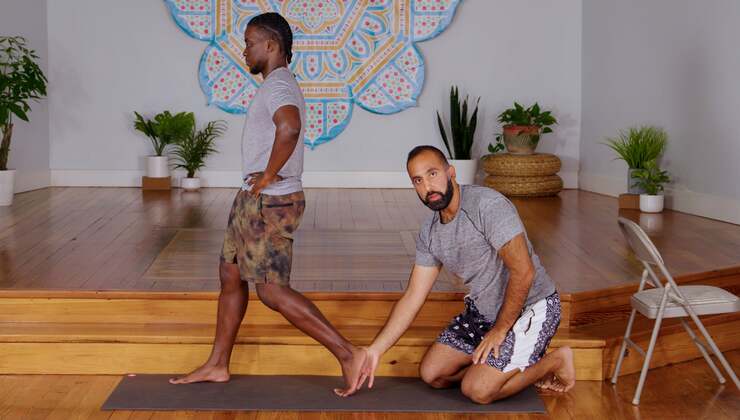
20:07
Knee Health in Warrior Pose with Sumair
video• 20:07• Premium
About this video
Type: video
Duration: 20:07
Access: Premium Content
Permalink: knee_health_in_warrior_pose
Notes List

Diane Verrochi2022-03-30 18:12:38 UTC
How frequently/consistently would you recommend doing these exercises? And for how long?

Liesbeth2022-02-20 09:59:44 UTC
Thank yoi so much Sumair! This was very helpfull. I have always had a problem with the arches of my feet collapsing in so it's so nice to have a way to train this now. What kind of schedule would you recommend for this?

Margi Alston2022-02-18 08:50:03 UTC
Really good explaination Sumair and to see Nick’s demomsration was excellent, I can now visulise the whole process and pay carefull attention.gave great meaning an

Samantha Kies-Ryan2022-07-18 21:40:14 UTC
Thanks for this Sumair. Could you do another one on feet? My feet have been getting very tight anc sore over months and this tightness seems to refer up to my knees, hips and lower back. Thise foot exercises did seem to help loosening the tension and relaxing

Alison Swallow2022-03-19 14:15:22 UTC
Thank you this was super informative and helpful 🙏🏻

Natalie ONeill2022-03-18 17:01:45 UTC
Thank you Sumair and Nick! These health videos are just what I need! I feel encouraged to move more without fear of pain.
I love learning about the connection of all the joints and muscles.
Adding this into practice makes me stronger and more stable.

Barbara N2022-03-14 03:21:44 UTC
Wow! found this really interesting, thank you Sumair (& Nick)!
I have osteo arthritis in my big toe, a neuroma between my 2nd and 3rd and a problematic bunion all on my left foot but I think I can still work on this. I don't have a tennis nor golf ball on hand at the moment but I was able to try the other moves. I might try the suggestion for a pillow under the problem foot in future.
Also, I second the request for some exploration of wrists and elbows!

Jamie2022-03-11 02:55:50 UTC
Wow I love how I discover so many new parts of my body and new sensations and muscles and connections when I watch your videos, Sumair. Thank you! And thank you, Nicholas, for the clear demonstration!

Lauren Walker2022-03-03 14:28:41 UTC
Amazing video, thank you so much. And an extra big thank you from my toes. This is sure to become a regular practice for me 🙏🏻

Maribel Garcia2022-03-02 06:08:31 UTC
Great video! Thank you for the tips. 💯🙏🏻
Related Contents


Quick Stats
Content ID#1539028
Category#
Typevideo